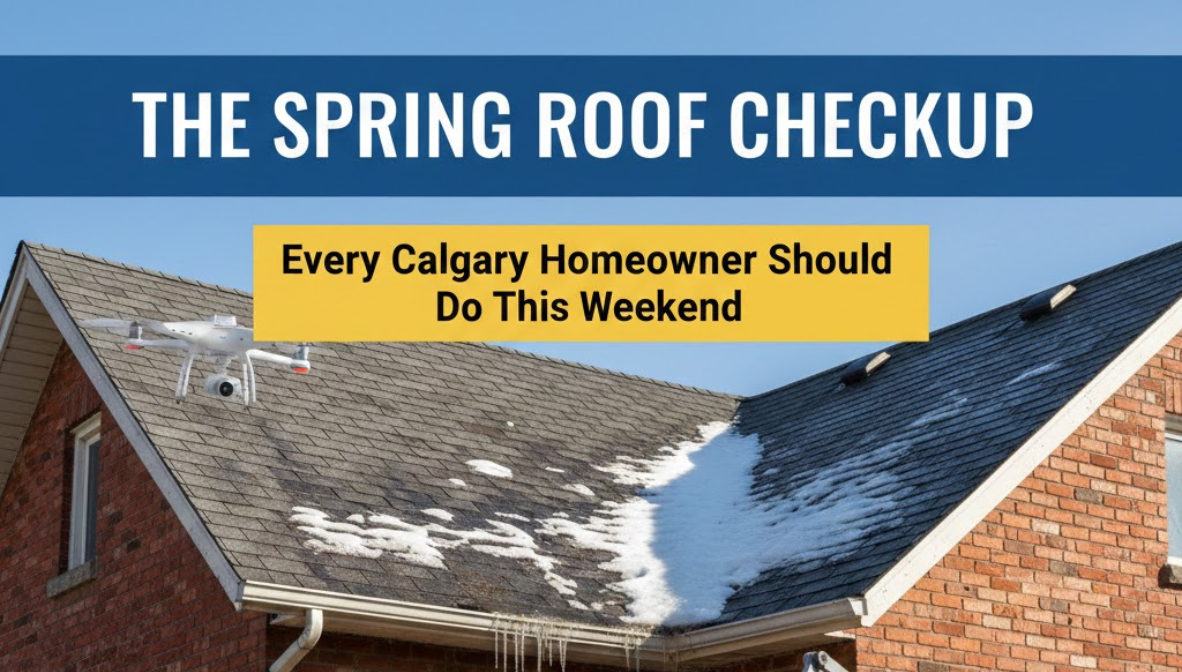
Your Roof Just Survived Another Calgary Winter — Find Out What It Cost
Spring in Calgary is a relative term. Winter doesn’t really let go until mid-May some years, and even then it might throw one last snowstorm at you for old times’ sake. But at some point the melt happens, the temperatures stabilize, and your roof finally gets a break from months of punishment. Heavy snow loads, ice accumulation, Chinook temperature swings, wind that rattles the windows — your shingles have been absorbing all of it since October.
That’s exactly why spring is the right time to look for damage. Everything that happened over the winter is visible now, and catching problems early — before they spend all summer getting worse — is the difference between a minor repair and a major headache. You don’t need professional equipment for the first pass. A pair of binoculars, a flashlight, a free afternoon, and a willingness to actually look is enough to spot most of the obvious issues.
Start From the Ground — Walk the Full Perimeter
You don’t need to climb onto anything yet. Walk all the way around your house with binoculars and look at the roof from every angle. You’re scanning for the big stuff: missing shingles, cracked shingles, tabs that are visibly curling upward. A ridge line that dips or sags where it should be straight. Debris sitting in the valleys where two roof slopes meet — leaves, branches, anything that’s been accumulating.
While you’re down there, look at the ground too. After winter, you’ll often find evidence of roof damage at ground level before you see it on the roof itself. Pieces of shingle in the garden beds. Chunks of old sealant on the sidewalk. Dark, sand-like granules washing out from the downspout exits or collecting against the foundation. Some granule loss is normal, especially on newer shingles. But on an older roof, heavy granule shedding means the protective surface layer is failing and the shingle material is increasingly exposed to UV and moisture.
Gutters and Downspouts Need Their Own Dedicated Look
Calgary winters destroy gutter systems quietly. Ice bends mounting brackets. Frozen water pushes seams apart. Debris that was sitting in the gutters last fall got buried under ice and is now a soggy, compacted mess blocking water flow.
Clean everything out. Remove leaves, twigs, sediment, and the granule sludge that accumulates over the season. Then check the physical condition of the gutters themselves. Are they still firmly attached to the fascia board, or have brackets pulled loose? Are the gutters level, or have sections sagged so water pools instead of flowing toward the downspouts?
Follow the water path all the way to the bottom. Downspouts should discharge at least four to six feet from the foundation. If they’re dumping water right at the base of the house, you’re setting yourself up for foundation issues and potential basement leaks. Extensions are cheap and easy to install.
Get Into Your Attic With a Flashlight
If you have safe access to your attic — even just a hatch in a hallway closet — spend ten minutes up there with a good flashlight. This is where winter damage reveals itself most honestly, because nobody ever looks.
Check the underside of the roof deck. You’re looking for dark stains, discolouration, any signs of moisture. Press on the wood in a few spots — it should feel solid and dry. Soft, spongy areas indicate water damage and possibly the beginning of rot.
Look at the insulation. Is it dry and fluffy, sitting evenly across the attic floor? Or is it compressed, damp, discoloured, or shifted around? Wet insulation means water is getting in from somewhere — through the roof, through condensation from poor ventilation, or from a bathroom vent that terminates in the attic instead of venting outdoors.
Use your nose. A musty, earthy smell in the attic is one of the clearest signs of mould growth. Mould thrives in damp, enclosed spaces and can be spreading across sheathing and rafters without any visible indication from inside the house.
Finally, turn off your flashlight and look for daylight. Any point of light visible through the roof deck means there’s a hole — and if light can get through, so can water.
Flashing Needs a Close Examination
Flashing — the metal strips installed around chimneys, vents, skylights, and roof-to-wall junctions — takes an extraordinary beating during Calgary winters. Every Chinook event cycles the metal through expansion and contraction. The sealant that bonds flashing to surrounding surfaces dries out, cracks, and pulls away over time.
From the ground (or with binoculars), look for visible gaps between flashing and the adjacent surface. Check for rust or corrosion, especially on galvanized steel flashing that’s been in place for more than a decade. Look for sealant that’s peeling, crumbling, or missing entirely. Even small gaps let water into the roof structure, and flashing leaks are notorious for causing damage that stays invisible for months.
If you have a chimney, give it extra attention. Chimney flashing is the most complex assembly on most roofs and the most common failure point in Calgary’s climate. The step flashing along the sides, the counter flashing embedded in the mortar, the cricket or saddle on the uphill side — any component can fail, and when one does, the volume of water that enters the wall and roof structure is alarming.
Low-Slope and Flat Sections Are Easy to Forget
If your home has any flat or low-slope roof sections — over a garage, a porch, or a room addition — check them carefully. These areas don’t drain as quickly as sloped surfaces, and they’re prone to ponding water that sits and slowly degrades the membrane. Look for bubbles, cracks, or areas where the membrane appears to have separated from the deck beneath. Make sure any drains or scuppers are completely clear of debris.
Standing water on a flat section after a rainfall is a problem. It means the drainage isn’t working, and every hour that water sits there accelerates deterioration. This is worth addressing quickly.
Soffits, Fascia, and the Critters Who Love Them
The soffit panels under the eaves and the fascia boards along the roofline are vulnerable spots that often get overlooked during inspections. Ice damage is common along these surfaces. Moisture causes paint to peel and wood to soften. And animals — squirrels, birds, raccoons — are remarkably good at finding small gaps and turning them into entry points.
Walk along the eave line and look for peeling paint, rotted wood, gaps between panels, and any openings that look new or enlarged. If you can see chewed edges or hear scratching sounds in the attic, something has moved in. Dealing with it early prevents both the animal damage and the much larger problem of having insulation torn up and contaminated by nesting materials and droppings.
Skylights Are Silent Troublemakers
If your home has skylights, check them from both inside and outside. From inside, look at the ceiling around the skylight frame for any water stains, discolouration, or bubbling paint. From outside (or with binoculars), look at the flashing and seals around the skylight perimeter. Condensation between double-pane skylight glass means the seal has failed — the unit will need to be replaced eventually, though it’s not an urgent roof issue.
Skylight leaks often develop gradually and are easy to dismiss early because the first signs are subtle — a slight discolouration on the ceiling that could be a shadow, a faint musty smell in the room. By the time the leak is obvious, the surrounding roof structure may have sustained significant moisture damage.
Factor In the Age of Your Roof
Everything you observe during a spring inspection needs to be interpreted in context, and the biggest piece of context is age. A five-year-old roof with a few loose granules is probably fine. A 20-year-old roof with the same symptoms is telling you something very different.
If your shingles are approaching 20 years, this isn’t just a damage check — it’s a life-expectancy assessment. The material itself has been through hundreds of freeze-thaw cycles, years of UV exposure, and possibly multiple hail events. It may look passable from the ground while the underlying asphalt is brittle, the granule layer is thin, and the adhesive bonds between tabs are failing. Knowing where you stand lets you budget for a replacement on your timeline rather than scrambling after a mid-winter failure.
Trim Overhanging Branches While You’re At It
While you’re outside examining the roof, look at the trees around your house. Branches that overhang the roof drop leaves and needles directly into gutters, trap moisture against shingles, and scrape the surface during wind events. In a storm, a heavy limb can damage shingles, flashing, or even the decking underneath.
Keep branches trimmed back at least six feet from the roof surface. This is an easy thing to let slide because trees grow gradually — the branch that was safe last spring might be touching the eaves this year.
A Professional Inspection Catches What You Can’t
A DIY walk-around is a great starting point and will flag the most visible issues. But a trained roof inspector gets up on the roof, checks every square foot at close range, evaluates decking condition, tests ventilation airflow, and recognizes early-stage damage that simply isn’t visible from the ground or from inside the attic.
If your roof is more than 10 years old, or if your DIY check turned up anything concerning, a professional spring roof inspection is money well spent in Calgary. It catches the small problems while they’re still small and gives you a clear picture of where you stand heading into summer.